
Table of contents
BetaList alternatives give founders different ways to introduce a startup: a daily product launch, a weekly board, a month-long launch cycle or a project shared within a professional network. The right choice depends on who you want to reach, when you want to launch and which submission requirements you can meet.
This guide compares PeekLaunch, Product Hunt, Uneed, Microlaunch and Peerlist Launchpad. They can complement BetaList rather than replace it.
Disclosure: We run PeekLaunch. This comparison explains where our platform fits and when another option may suit you better. Product details were checked on 8 November 2026 (IST); check the linked official pages before submitting.
What BetaList offers, and why consider alternatives
BetaList helps early adopters discover new internet startups. It is not limited to products that have yet to launch. Its official FAQ says it features pre-launch waitlists, private betas and products that are already live. What matters is being new to its audience.
BetaList uses editorial selection. Its criteria include a clear value proposition, good design and an innovative idea. Startups need their own domain; free hosting subdomains and direct app-store links are not accepted under its stated rules.
All submissions are now paid. BetaList says it automatically refunds the full payment if a startup is not selected. Check current prices and expected timelines during the submission process.
You might consider another channel because you need a free submission route, prefer a different launch schedule or want to reach a particular community. That does not make BetaList a poor choice. It means the launch process and audience should match your product.
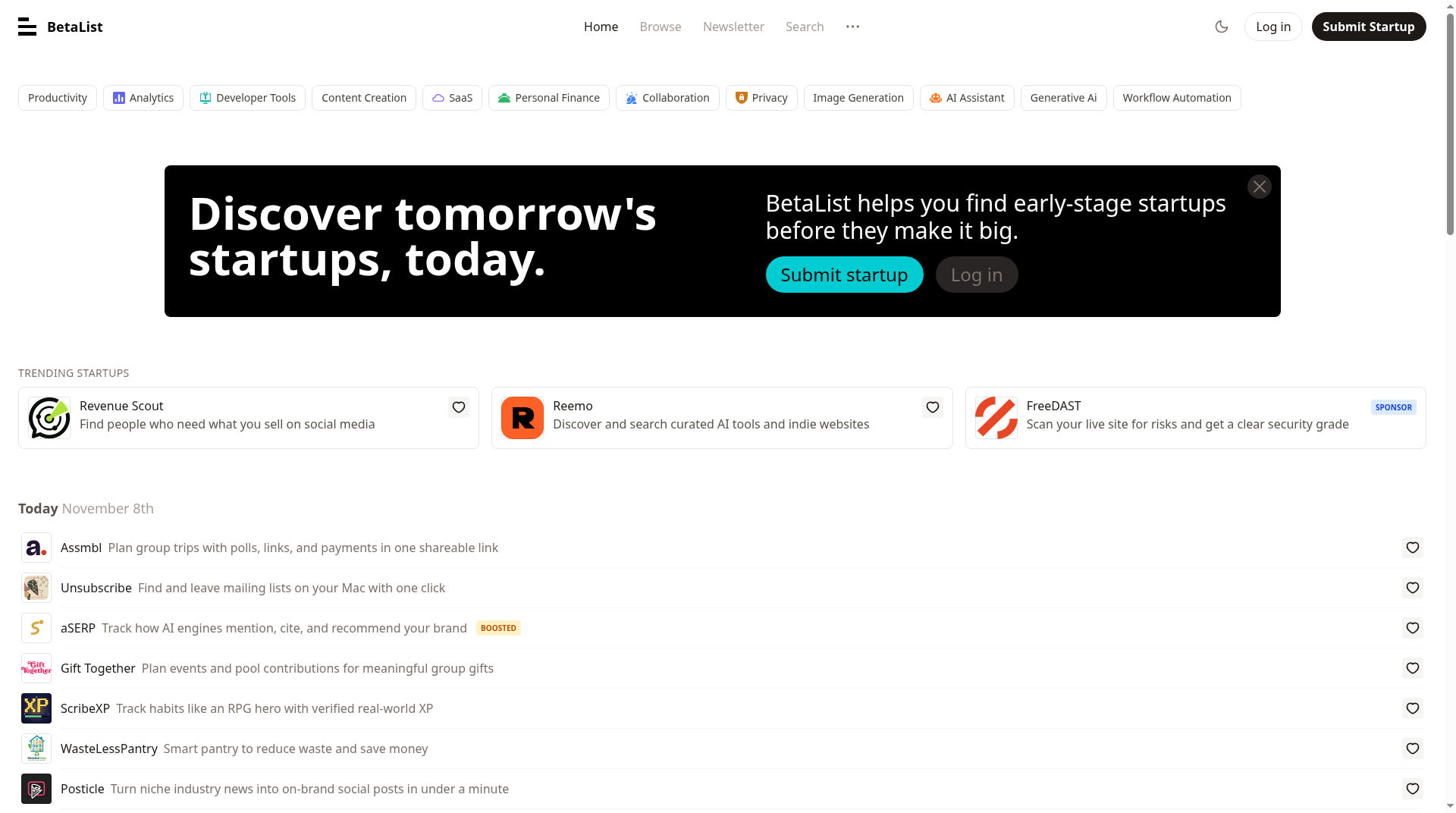
BetaList homepage, captured 8 November 2026 (IST). Listings change. Source: BetaList.
Five alternatives compared at a glance
This compares launch formats and practical fit, not traffic or expected results.
PeekLaunch
Launch format: Weekly product board
Reason to consider it: A Free route and optional one-time upgrades
Check first: Free-seat availability and website verification
Product Hunt
Launch format: Daily product launches
Reason to consider it: Its maker and technology community
Check first: Launch preparation and submission guidelines
Uneed
Launch format: Daily product launches
Reason to consider it: Queue and paid scheduling options
Check first: Assigned date and conditions for keeping a free listing published
Microlaunch
Launch format: Monthly product launches
Reason to consider it: A launch organized around a monthly cycle
Check first: Current submission terms and timing
Peerlist Launchpad
Launch format: Weekly project launches
Reason to consider it: Launching within a professional network
Check first: Profile, project and launch eligibility requirements
A similar-looking leaderboard does not mean an identical audience. Before choosing, browse recent products in your category and read the discussions around them. Consider whether those readers are plausible users of what you are building.
PeekLaunch: weekly launches and optional one-time upgrades
PeekLaunch is a product launch and discovery platform for indie makers, SaaS founders and small teams. Products launch on weekly boards and have public listing pages.
The Free plan has 25 seats per ISO week. Before a Free listing can be scheduled or go live, you must verify a PeekLaunch badge or a link to your product page on your website. The verification proof needs to be available in server-rendered HTML; a widget rendered only by client-side JavaScript can fail the check.
If a week is full, you can choose a later available week or consider a paid upgrade. The regular prices are $9 for Premium and $19 for Premium+, each charged once per product rather than monthly. Introductory offers may differ; see current pricing.
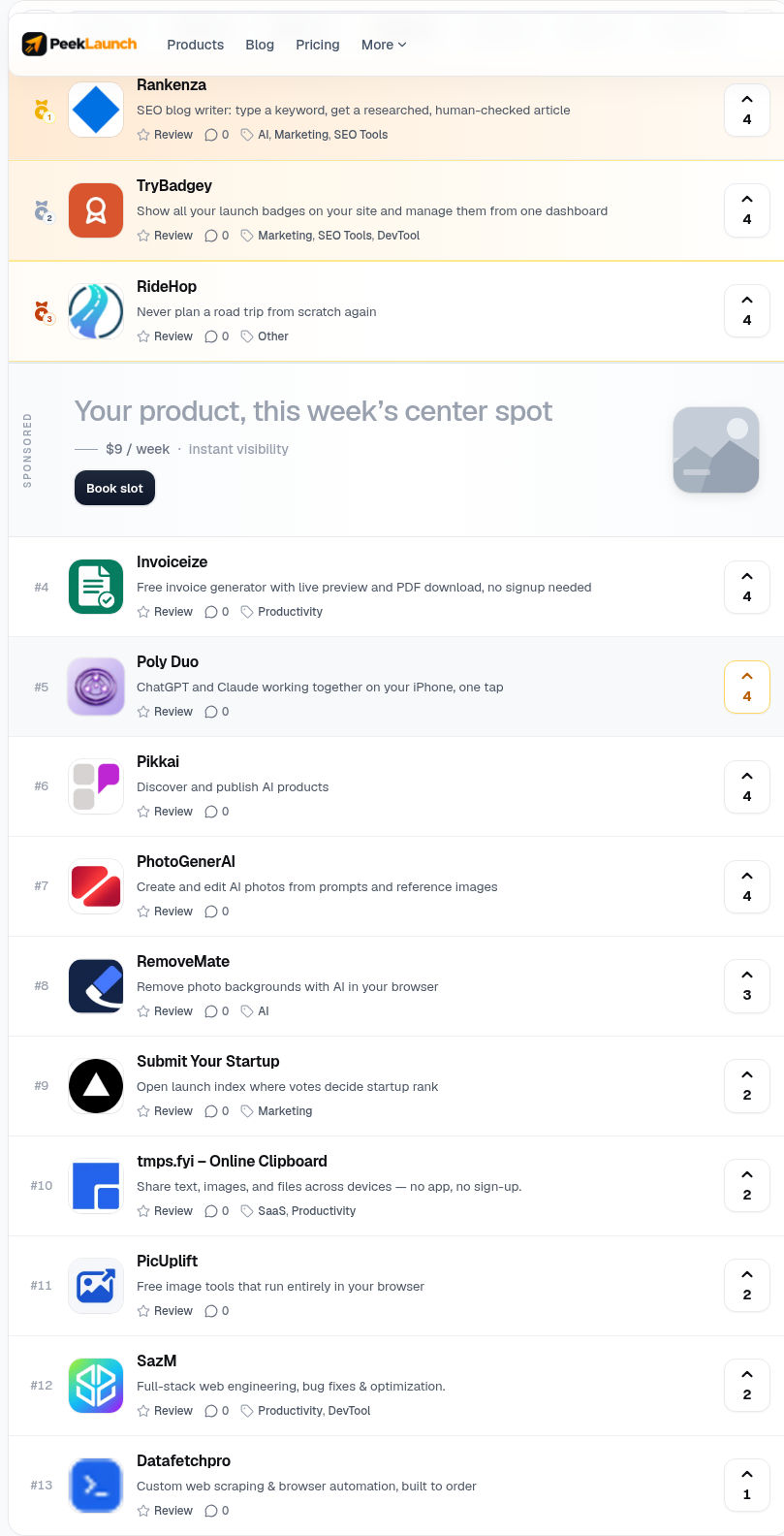
PeekLaunch weekly launch board, captured 8 November 2026 (IST). Listings and positions change. Source: PeekLaunch.
Both paid plans bypass the Free-seat cap and badge requirement for the upgraded product. Paid status also affects board placement, so Free and paid listings should not be assumed to receive identical positioning.
PeekLaunch fits founders who want a weekly launch destination and can work with these published conditions. A listing can remain in the public catalog after its launch week while it stays live and eligible, but we do not guarantee a lifetime listing. Joining halfway through a week also does not provide a full seven days on that week's board.
Choose PeekLaunch if its weekly format, Free submission route and optional per-product upgrades suit your plans. The FAQ explains the listing and verification rules. As with any launch channel, referral traffic, customers, Google rankings, indexing and AI citations are not guaranteed.
Product Hunt and Uneed: daily-launch options
Product Hunt
Product Hunt organizes new product launches around a daily feed and community discussion. Its launch guide confirms that using the platform is free and makers can submit their own products. You do not need a third-party hunter.
Consider it when you have a product ready to explain, clear screenshots or a demo, and time to answer questions around the launch. Submitting is not a guarantee of homepage featuring, and a daily leaderboard position is not a customer-acquisition result.
Product Hunt also has persistent product pages, so lasting product information is not an exclusive advantage of PeekLaunch. For a closer comparison, see our Product Hunt alternative guide.
Uneed
Uneed is another daily product-launch option. Its current pricing page makes the timing tradeoff important: the join-the-line route assigns a launch date at least 50 days out.
It also states that an upvote score of 10 is needed to stay published on that route. Paid scheduling options are available, but check the current package details before choosing one.
Uneed is worth considering if you prefer a daily launch and can plan around the assigned date or pay for a scheduling option. If you need a particular week, compare available dates before preparing your announcement. Neither a free submission nor a paid slot guarantees qualified visitors.
Microlaunch and Peerlist Launchpad: different launch formats
Microlaunch
Microlaunch presents new products through a monthly launch cycle, with product votes and reviews visible on its board.
That format may suit a founder who prefers a monthly launch context to concentrating on a daily event. It does not mean every listing receives sustained attention throughout the month. Your product description, audience fit and follow-up still matter.
Check its current submission options and timing before committing. Current submission pricing was not verified for this comparison, so no exact price is quoted here.
Peerlist Launchpad
Peerlist Launchpad uses a weekly launch format within Peerlist’s professional network.
It is worth considering if you want to introduce a project alongside your professional identity. Before submitting, check the current profile and project requirements and browse the kinds of projects being shared.
Compare Launchpad with PeekLaunch as a launch channel, not as a replacement for the whole Peerlist network. If your goal also includes building professional connections, that wider setting may be part of its appeal. If your immediate need is a dedicated product listing, focus on the launch requirements and presentation each platform offers.
When BetaList is still a good fit
BetaList remains a sensible option when your startup meets its editorial criteria and you specifically want to introduce it to an early-adopter audience.
You do not need to avoid it just because your product is already live. Its stated focus includes launched products that are new to its audience. Conversely, being early-stage alone does not guarantee selection.
Its review process may also suit a founder who prefers an editorially selected listing to a leaderboard-led launch. Before paying, review the plan’s expected timeline and newsletter terms. The refund if not selected reduces the risk of paying for a rejected submission; it does not guarantee signups after acceptance.
You can use BetaList and another platform for different purposes. An early-adopter introduction and a later launch announcement can be separate activities, provided each submission meets the relevant platform's rules.
How to choose your launch channels and measure results
Start with one goal: feedback, qualified signups, trial activations or purchases. “More visibility” is difficult to evaluate unless you define what you want visitors to do.
Then choose channels using four checks:
Audience: Are recent products and discussions relevant to your prospective users?
Timing: Can you meet the submission deadline, queue or launch cycle?
Requirements: Can you satisfy the website, profile and verification rules?
Cost: Is the fee justified by a specific feature you need, without assuming a return?
Use a distinct tracking link for each channel where its submission rules allow it. Record the listing URL, launch date, spending and time invested. Measure what happens after the click: relevant trial users can be more useful to your business than a higher vote count.
Spread launches out if that helps you answer questions and distinguish results. Avoid treating a platform's total audience as the number of people who will see your listing.
If a weekly board fits your plan, explore PeekLaunch and check whether an available Free week and the verification requirements work for you. Choose an upgrade only if its additional features meet a concrete need.
About the Author & Editorial Standards

Sahil Khan
Curator & FounderFounder & Lead Editor at PeekLaunch · Full-Stack Builder & Tech Reviewer
Sahil is an independent builder and web engineer who reviews, benchmarks, and writes in-depth evaluations of tech products, SaaS platforms, and launch ecosystems. At PeekLaunch, he leads product curation, technical verification, and directory indexing.
Experience & Expertise
Hands-on software development experience across web applications, SEO indexing, and SaaS architecture.
Authoritativeness & Trust
100% fact-checked, firsthand tested editorial standards. Stories are independently verified prior to publication.